


“When women and girls are denied justice, the damage goes far beyond any single case. Public trust erodes, institutions lose legitimacy, and the rule of law itself is weakened. A justice system that fails half the population cannot claim to uphold justice at all.”
– Sima Bahous, UN Women Executive Director
Every year on March 8, the world pauses to honor the courage, resilience, and achievements of women across generations. International Women’s Day (IWD) is more than a celebration-it is a call to action, a reminder of struggles endured, and a challenge to dismantle the barriers that continue to deny women and girls their rights. This year, 2026, the UN Women theme is: “Rights. Justice. Action. For ALL Women and Girls”-focuses sharply on the persistent legal and social inequalities that continue to shape the lives of women globally.
The roots of this day are deeply historical. In 1908, 15,000 women marched through the streets of New York, demanding shorter working hours, fair wages, and the right to vote. Two years later, in 1910, over 100 delegates from 17 countries gathered in Copenhagen for the Second International Conference of Working Women. At this historic gathering, Clara Zetkin, head of Germany’s Social Democratic Party Women’s Office, proposed an annual International Women’s Day-a single, worldwide day to champion women’s rights and amplify their voices. Her visionary idea was embraced unanimously, sowing the seeds for the IWD we honor today.
The momentum continued. In 1917, Russian women struck for “Bread and Peace” on March 8, contributing to the Tsar’s abdication and paving the way for women’s suffrage. The United Nations officially recognized IWD in 1975, cementing its global significance as both a celebration and a platform for advocacy.
Despite decades of progress, equality remains uneven. Globally, women hold only 64% of the legal rights of men (UN Women). Discriminatory laws, weak enforcement, societal bias, and gender-based violence continue to undermine equality. From sexual and reproductive health to economic participation, women face unique and often overlooked challenges shaped by social, cultural, and economic forces. Violence against women is alarmingly pervasive: nearly one in three women experience physical or sexual violence in their lifetime.
UN Women’s 2026 report underscores the stakes: “When women and girls are denied justice, the damage goes far beyond any single case. Public trust erodes, institutions lose legitimacy, and the rule of law itself is weakened.” Rights on paper are not enough; justice must be tangible, and action must follow.
In South Asia, the struggle for justice and equality takes on distinctive dimensions. Women often face barriers to education, economic independence, and safety, especially in rural communities. Yet they are also engines of change. Across India and Bangladesh, women are leading grassroots initiatives, running microfinance programs, managing farms, and taking charge of local governance. They advocate for safe workplaces, equal pay, and access to healthcare, proving that progress is possible even amid systemic challenges.
In Bangladesh, women’s contributions are particularly remarkable. Millions are employed in the garment industry, powering the global economy while demanding fair wages and safer working conditions. Microfinance initiatives have empowered women to become entrepreneurs and community leaders. Education rates for girls are steadily rising, and rural women are increasingly assuming leadership roles in village councils and cooperatives. These stories illuminate the transformative impact of providing women with the tools, support, and rights they deserve.
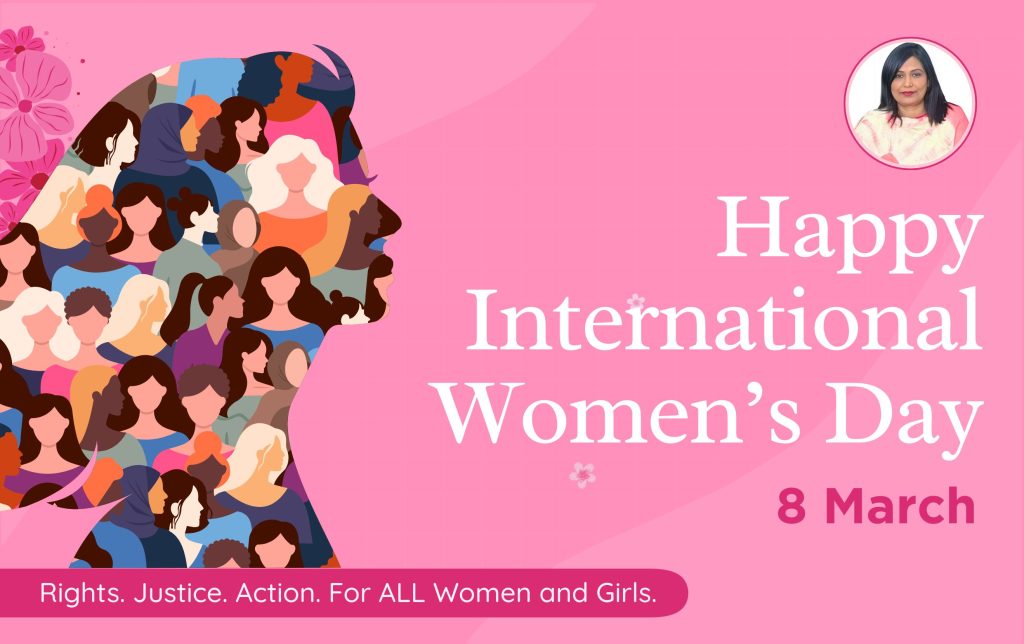
This International Women’s Day reminds us: rights are not enough without justice, and justice is not enough without action. To build a truly sustainable world for all women and girls, governments and institutions must actively dismantle structural barriers to equality: ending discriminatory laws, strengthening legal protections, and challenging harmful practices and social norms that erode women’s rights.
IWD 2026 calls on all of us-governments, institutions, communities, and individuals-to act with intention and resolve. Justice systems must deliver equality: laws must protect women from violence and discrimination, courts must believe survivors, legal aid must be accessible, and support systems must facilitate recovery. Only when society chooses justice does progress become irreversible.
In Bangladesh and India, where women are increasingly stepping into public, economic, and political roles, the future depends on reinforcing these gains while tackling persistent barriers to equality.
International Women’s Day is a moment to reflect, celebrate, and mobilize. It reminds us that every legal reform, every act of advocacy, and every step toward equality matters. For students, educators, and citizens alike, it is a call to witness and participate in history: to learn, to act, and to ensure that no woman or girl is left behind.
This March 8, we honor the courage of those who fought for the rights we enjoy, recognize the work that remains, and recommit to a world where justice, equality, and dignity are not privileges for some, but guaranteed for all women and girls.
Writer: Dr. Usharani Boruah, librarian & gender coordinator, CIRDAP