














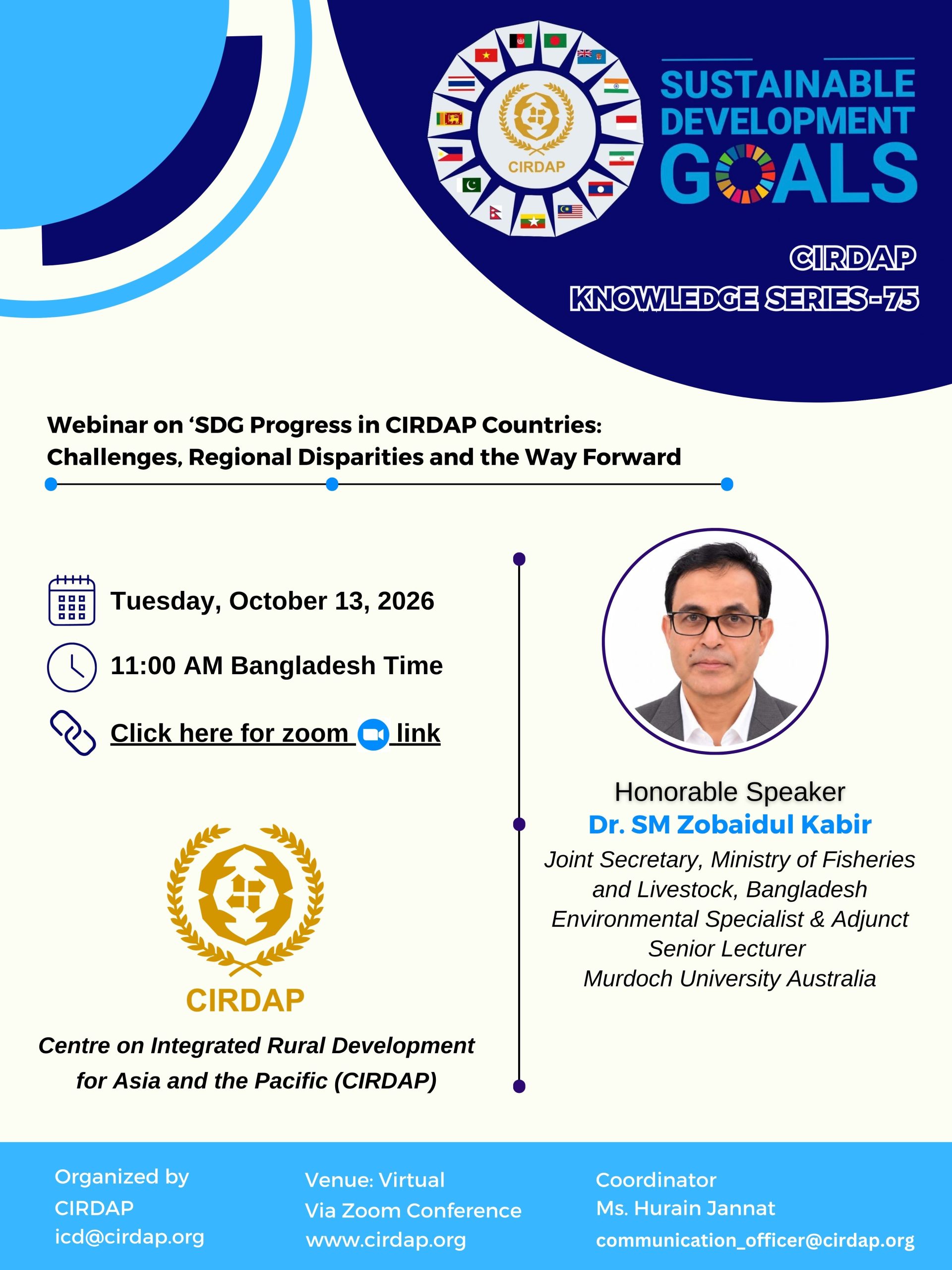
Date: Tuesday, October 13, 2026
Time: 11:00 am Bangladesh Time
Esteemed Speaker:
Dr. SM Zobaidul Kabir
Joint Secretary, Ministry of Fisheries and Livestock, Bangladesh
Environmental Specialist & Adjunct Senior Lecturer
Murdoch University Australia
Webinar Link
Topic: Webinar on Sustainable Development Goals and CIRDAP member states: achievements and way forward’
Time: Oct 13, 2026 11:00 AM Dhaka
Join Zoom Meeting
https://zoom.us/j/97330082920?pwd=MYnneroLVJADokNLvANvBsgsaIxGyC.1
Join and take notes
https://zoom.us/j/97330082920?pwd=MYnneroLVJADokNLvANvBsgsaIxGyC.1&mynotes=on
Meeting chat link
https://zoom.us/launch/jc/97330082920
View meeting insights
https://zoom.us/launch/edl?muid=6f965040-5448-4a28-af6e-32e5ead13430
Meeting ID: 973 3008 2920
Passcode: 685825
—
One tap mobile
+16694449171,,97330082920#,,,,*685825# US
+16699006833,,97330082920#,,,,*685825# US (San Jose)
—
Join by SIP
• 97330082920@zoomcrc.com
Join instructions
Abstract of the Webinar:
SDG Progress in CIRDAP Countries: Challenges, Regional Disparities and the Way Forward
Zobaidul Kabir[1]
Abstract
The Sustainable Development Goals (SDGs) offer a shared global framework for tackling some of the most pressing challenges facing societies today, including poverty, inequality, unemployment, environmental degradation and climate change. Despite significant progress in several areas, the Asia-Pacific region remains substantially off track to achieve the 2030 Agenda. This paper reviews progress, persistent implementation challenges and opportunities for accelerating SDG action across the 15 member countries of the Centre on Integrated Rural Development for Asia and the Pacific (CIRDAP).
The paper focuses particularly on rural areas, where many of the region’s most persistent development challenges intersect. Rural communities continue to experience poverty, limited employment opportunities, unequal access to education and health services, weak infrastructure, gender disparities and increasing exposure to climate-related hazards. At the same time, agriculture and natural-resource-based livelihoods are under growing pressure from environmental degradation, changing climatic conditions and rapidly changing markets. Evidence suggests that these challenges are closely connected and cannot be addressed effectively through isolated sectoral interventions. If current trends continue, the CIRDAP region is likely to miss 103 of 117 measurable SDG targets by 2030, underscoring the urgency of moving from commitments to implementation.
The paper recommends that CIRDAP countries need to move beyond conventional approaches to rural development and pursue integrated, inclusive and climate-resilient rural transformation. It identifies seven closely connected areas for accelerated action: integrated planning and localization of the SDGs; sustainable and resilient agrifood systems; climate-resilient infrastructure and basic services; green, digital and decent employment; inclusive social development and gender equality; stronger financing, data and monitoring systems; and expanded South–South cooperation and knowledge sharing. Experiences from CIRDAP countries illustrate both the scale of the challenges and the possibilities for locally grounded solutions.
The paper proposes a CIRDAP SDG Acceleration Framework that may bring these priorities together and links national commitments with local action, investment, institutional coordination and measurable results. It concludes that the remaining years to 2030 should be used primarily to implement, invest, measure and learn, rather than continually developing new strategies. CIRDAP can play a distinctive role by connecting national SDG priorities with the realities of rural communities and by creating a stronger platform for shared learning, practical solutions and collective action across its member countries.
Keywords: Sustainable Development Goals, CIRDAP, SDG implementation, Progress, Way Forward.
[1] Joint Secretary, Bangladesh Planning Commission, and adjunct Faculty Murdoch University, Australia. Emails: smzobaidul@gmail.com