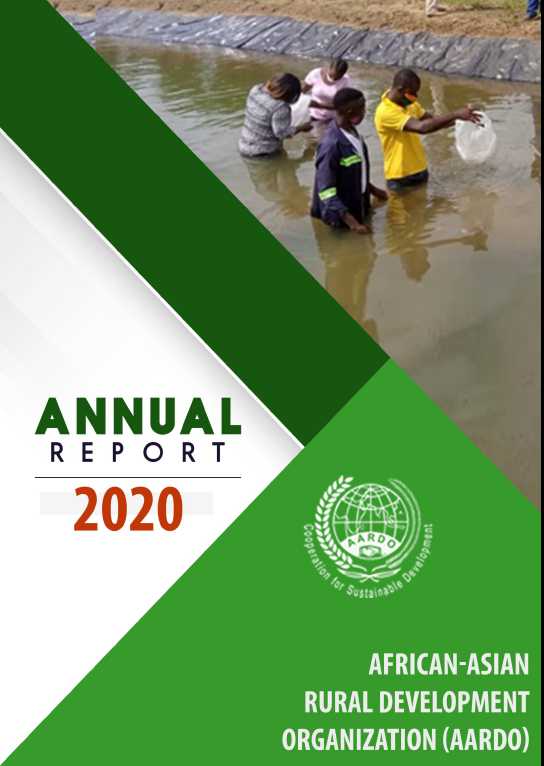
Anuual Report 2020
African-Asian Rural Development Organization (AARDO)
Click here to see the full report.
CIRDAP – Enabling Rural Communities
















Click here to see the full report.
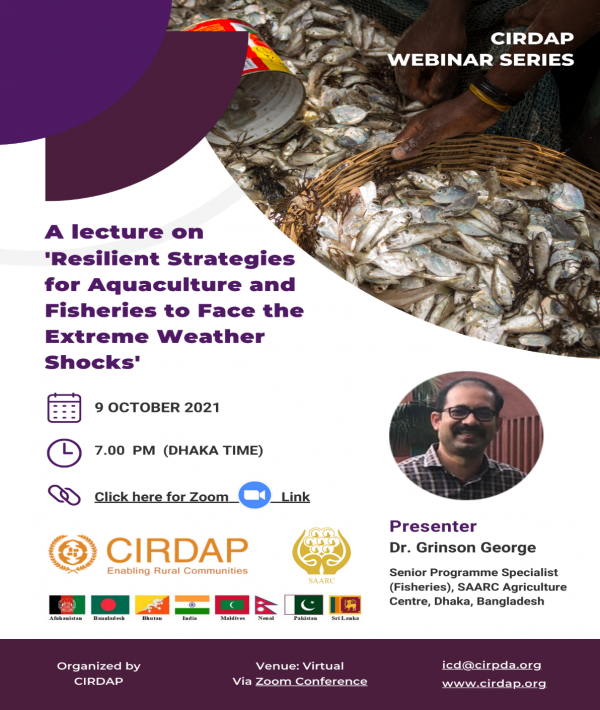
Please join the next webinar of CIRDAP webinar series on 9th October, 2021 at 7.00 pm Bangladesh time Zoom link of the event CIRDAP HQ is inviting you to a scheduled Zoom meeting. Topic: A lecture on ‘resilient strategies for aquaculture and fisheries to face the extreme weather shocks’. Time: Oct 9, 2021 07:00 PM Astana, Dhaka Join Zoom Meeting click here Meeting ID: 840 1252 7478 Passcode: 655686 One tap mobile +12532158782,,84012527478#,,,,*655686# US (Tacoma) +13017158592,,84012527478#,,,,*655686# US (Washington DC) Dial by your location +1 253 215 8782 US (Tacoma) +1 301 715 8592 US (Washington DC) +1 312 626 6799 US (Chicago) +1 346 248 7799 US (Houston) +1 646 558 8656 US (New York) +1 669 900 9128 US (San Jose) Meeting ID: 840 1252 7478 Passcode: 655686 Find your local number: click here
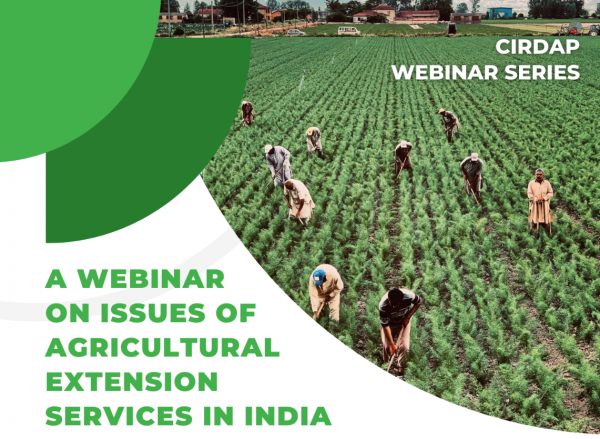
Under the Expert database of CIRDAP, the third webinar on Issues of Agricultural Extension in India” was held virtually on 3 October 2021. The presenter was Assistant Professor Dr. Binoy Goswami, South Asian University, New Delhi, India. Different participants, researchers and experts attended this webinar virtually. Dr. Goswami presented the topic to the audiences and after the presentation an interesting and fruitful discussions was held. ABSTRACT A dynamic agricultural extension delivery system can play an important role in increasing farm productivity and income. Using data from the Situation Assessment Survey, 2013, the paper analyses the status of and challenges confronting the agricultural extension in India. Our analysis finds that notwithstanding regional variations, about 58 percent farm households access extension services. However, a substantial portion of marginal and small farmers does not access extension mainly due to non-availability and lack of awareness about extension facilities available. Further, public extension is the least preferred source of extension. The estimated Probit model identifies age, sex and education of the head of the household, proportion of farmers among the family members, crop intensity, crop diversification, irrigation, farm size, awareness about minimum support price (MSP), social group and the region to which a farmer belongs as the factors that affect the decision to access extension. These factors also influence the choice regarding the source of extension service. The study suggests that provisioning of public extension must be improved in terms of inclusiveness, and quantity as well as quality of manpower. Organizing farmers into groups based on crops that they cultivate, and linking such groups to agri-business can improve access to and quality of extension.
Under the Expert database of CIRDAP, the 2nd webinar on “Indian Youth Development Index and Global Youth Development Index with particular reference to CIRDAP Member Countries” was held virtually on 27th September, 2021. The presenter was Prof. Vasanthi Rajendran, Rajiv Gandhi National Institute of Youth Development (RGNIYD), Tamil Nadu, India. Different participants, researchers and experts attended this webinar virtually. Dr. Rajendran presented the context of Global youth development index (GYDI) in reference to CIRDAP member countries. After the presentation a descriptive and fruitful discussions was held among the audiences. The GYDI measures six distinct domains that are considered key aspects of youth development: Health and Wellbeing, Education, Employment and Opportunity, Equality and Inclusion, Political and Civic Participation & Peace and Security. The YDI score is a number between 0 and 1, with 1 representing the highest possible level of youth development attainable across all indicators. A score of 0 therefore, reflects little to no youth development. The scoring system resembles that of UNDP’s Human Development Index. Please see the detail presentation of Prof. Rajendran at the webinar in the link below: click here
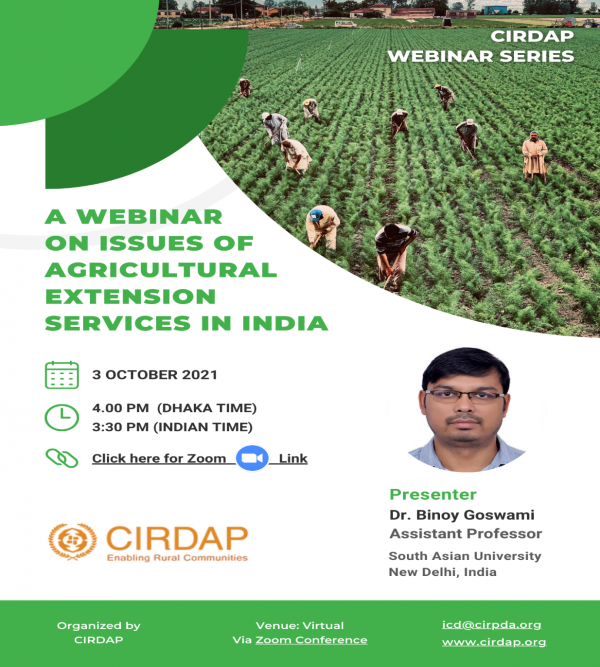
CIRDAP is going to organize a webinar on Issues of Agricultural Extension Services in India. The presenter will be CIPDAP Expert Assistant Professor Dr. Binoy Goswami, South Asian University, New Delhi, India. Date: 3 October 2021 (Sunday) & Time: 4.00 pm Bangladesh time. To join the webinar, please click the below zoom link: Topic: A Webinar on Issues of Agricultural Extension Services in India Time: Oct 3, 2021 04:00 PM Astana, Dhaka Join Zoom Meeting: click here Meeting ID: 822 3136 4964 Passcode: 308921 One tap mobile +12532158782,,82231364964#,,,,*308921# US (Tacoma) +13017158592,,82231364964#,,,,*308921# US (Washington DC) Dial by your location +1 253 215 8782 US (Tacoma) +1 301 715 8592 US (Washington DC) +1 312 626 6799 US (Chicago) +1 346 248 7799 US (Houston) +1 646 558 8656 US (New York) +1 669 900 9128 US (San Jose) Meeting ID: 822 3136 4964 Passcode: 308921 Find your local number: click here

HRH Princess of Thailand Maha Chakri Sirindhorn as the FAO Special Ambassador of Zero Hunger was invited as a Guest of Honor to deliver the Royal Statement (LIVE) at the Global Conference on Aquaculture Millennium +20 on 24 September 2021, Shanghai, PR China. Click here to see Global Aquaculture Declaration.
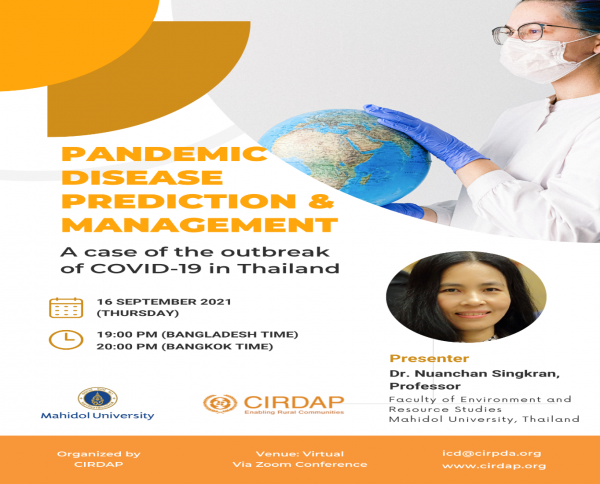
Abstract Similarly, to many countries across the globe, Thailand has faced the outbreaks of COVID-19 since early January 2020 with the dramatic loss in public health and socio-economics. More than 1.4 million infected people were observed in the country; and more than 15,000 cases of the infection were dead. The almost 2-year outbreaks of COVID-19 in Thailand were chronologically portrayed in this talk together with the results of the model predictions and trends from the 1st outbreak (12 January 2020) to the existing 4th outbreak (28 June 2021 – present). Besides, a cyclic disaster management was introduced for managing this pandemic disease in three periods, i.e., before, during, and after the pandemic events. Additionally, the effective COVID-19 management in some countries were discussed. Please see the detail presentation of Prof. Singkran at the webinar in the link below of the presentation: click here
Field of Interest :
Rural Development, Industrial Organization, Agricultural and Resource Economics, and Micro Econometrics.
Farmed fish and plants have long contributed to healthy diets, poverty alleviation and rural development. It is only recently, however, that aquaculture has grown to be the leading source of aquatic food, which is expected to meet expanding global dietary demands while also addressing the food security needs of the poor. In order to accelerate the growth and ensure the sustainability of future aquaculture, FAO and NACA with the Chinese Ministry of Agriculture and Rural Affairs invite governments, business, academia and civil society to discuss the theme “Aquaculture for Food and Sustainable Development”. Announcement The GCA+20 has been transformed to a hybrid event, with all international participants connecting remotely. While we had held onto hope to welcome everyone in person, the organizers have made this difficult decision in consideration of our collective safety and wellbeing. For virtual participants, the format creates several benefits: the GCA+20 is free to attend, participation is open, and there are no travel costs. Join the GCA+20 by registering for a series of virtual Zoom Webinars on Thursday 23 September and Friday 24 September. Please see the full announcement for details on how to join the sessions. The format For virtual participants, the format creates several benefits: the GCA+20 is free to attend, participation is open, and there are no travel costs. Join the GCA+20 by registering for a series of virtual Zoom Webinars. Click on the links below to register for each individual session. For local participants already in China who wish to attend the GCA+20 in person, please contact 2020gca@shou.edu.cn. The GCA+20 will have simultaneous interpretation in Arabic, Chinese, English, French, Russian and Spanish, opening participation for everyone. The programme Nine thematic areas, three keynote speeches, over 100 academic posters and a technical workshop on Artemia are spread over three days of this dynamic programme. Click here to see the provisional programme online Click here to register for Plenary Click here to register for Stream 1 (Orange) Click here to register for Stream 2 (Green) Click here to register for Stream 3 (Purple) The Shanghai Declaration: Connect, collaborate and commit! The Shanghai Declaration represents a road map to optimize the role that aquaculture can play in achieving the 2030 Agenda for Sustainable Development. The draft Shanghai Declaration was prepared by a small group of globally recognized aquaculture experts, followed by consultations with a wider group with appropriate technical, regional and gender balance, including members of the International Organizing Committee and International Programme Committee. This draft is now open for comment by all registered participants, with the final text to be adopted on the last day of the GCA +20. All registered delegates are invited to provide their feedback and perspectives on the draft Shanghai Declaration (also available online here). The opportunity for providing feedback will be open until 03 September 2021. Only comments from registered participants will be considered; please include your registration number in your email. Registration is available at: click here In preparing your feedback, please bear in mind that we may receive responses from many participants and to keep the process manageable we encourage you to keep your feedback concise and focussed on major issues only. We also encourage organisations and cooperatives to provide collective feedback. We would appreciate it if you could follow the recommendations below when preparing your feedback: All feedback should be made in the comment sheet and sent by email to GCA@fao.org and include the following in the subject line of your email: your Registration Number (you can find this in the e-mail you received in response to your registration) your name and (if relevant) the organisation providing the collective feedback Please refer in your email to the chapter/section number you wish to address. Do not provide mark-up on the Working Document, as this will not be reviewed. The GCA +20 Secretariat will consider all feedback during the finalization of the Shanghai Declaration to the extent possible. To register in the conference and to know details of the declaration, please visit the links below: click here and click here
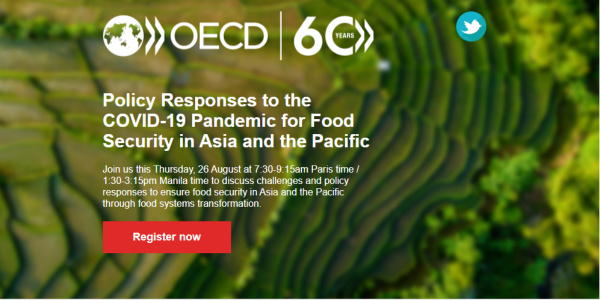
Policy Responses to the COVID-19 Pandemic for Food Security in Asia and the Pacific Join us this Thursday, 26 August at 7:30-9:15am Paris time / 1:30-3:15pm Manila time to discuss challenges and policy responses to ensure food security in Asia and the Pacific through food systems transformation. Event details and agenda Access the event website to learn more about how the event can help clarify the major regional policy agenda and access the detailed agenda with speaker information and a full program.