CIRDAP – Enabling Rural Communities

Centre on Integrated Rural Development for Asia and the Pacific (CIRDAP)

An Intergovernmental & Autonomous Organization; Established in 1979, Mandated for Promoting & Strengthening Integrated Rural Development Systems for 15 Asia-Pacific Countries; Namely Afghanistan, Bangladesh, Fiji, India, Indonesia, IR Iran, Lao PDR, Malaysia, Myanmar, Nepal, Pakistan, Philippines, Sri Lanka, Thailand & Vietnam.

Latest News

Latest News, Webinar report/abstract

Press Release
A Webinar on “e-commerce in Agriculture Sector for Rural Development
& Transformation Sharing Experiences of Thailand”

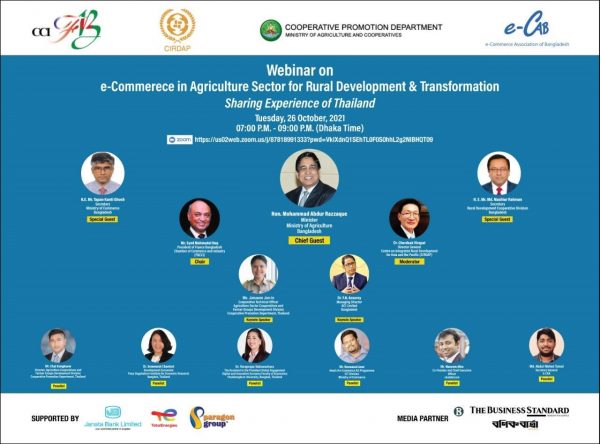
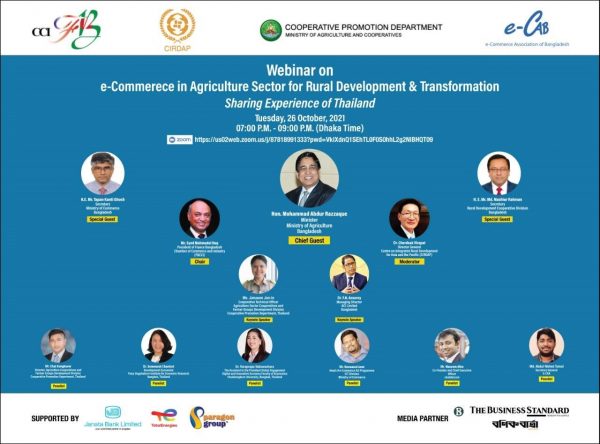
A webinar on “e-commerce in Agriculture Sector for Rural Development & Transformation Sharing Experiences of Thailand ” was held on Tuesday, October 26, 2021. The event was jointly organized by the France Bangladesh Chamber of Commerce and Industry (CCIFB) and the Centre on Integrated Rural Development for Asia and the Pacific (CIRDAP) in collaboration with e-Commerce Association of Bangladesh (e-CAB) and the Cooperative Promotion Department (CPD), Thailand’s Ministry of Agriculture and Cooperatives. The webinar started at 19:00 pm (Bangladesh Time) with an opening remark by the Chair, Mr. Syed Mahmudul Huq, President, CCIFB. The Chief Guest for the event was H.E. Dr. Mohammad Abdur Razzaque, Hon’ble Minister, Ministry of Agriculture, Government of Bangladesh. And the Special Guests included Mr. Tapan Kanti Ghosh, Secretary, Ministry of Commerce and Mr. Md. Mashiur Rahman, Secretary, Rural Development Cooperative Division. The webinar was moderated by Dr. Cherdsak Virapat, Director General, CIRDAP.   A brief introduction and background on the webinar were presented by Dr. Virapat and Mr. Chai Kongkaew, Director, Agriculture Sector Cooperatives and Farmer Groups, Cooperative Promotion Department (CPD), Ministry of Agriculture and Cooperatives, Thailand. The objectives of the webinar are to share knowledge and experiences on e-commerce in agriculture sector for rural development in Thailand and to take stock of Thailand’s experiences, to assess e-commerce readiness and to formulate a plan on pilot e-commerce in agriculture sector for rural development & transformation in Bangladesh.   The keynote presenter from Thailand, Ms. Jaruwan Jan-in, Director of Farmer Groups Development Group, Agriculture Cooperatives and Farmer Groups Development Division, Cooperative Promotion Department (CPD), Ministry of Agriculture and Cooperatives, Thailand delivered her presentation on “E-commerce Promotion in Thai Agricultural Cooperatives”. It was followed by two panelists, Dr. Voraprapa Nakavachara, Assistant to the President, Global Engagement, Digital and Innovative Economy, Faculty of Economics, Chulalongkorn University, Bangkok, Thailand, and Dr. Sommarat Chantarat, Development Economist, Puey Ungpakorn Institute for Economic Research, Bangkok, Thailand. From the Bangladesh’s side, the keynote speaker was Dr. F.H. Ansarey, Managing Director, ACI Limited, Bangladesh, and the panelists included Mr. Rezwanul Haque Jami, Head of e-Commerce A2i, Programme, ICT Division, Ministry of Commerce, and Mr. Waseem Alim, Co-Founder and Chief Executive Officer, Chaldal.   Dr. Cherdsak Virapat, Director General of CIRDAP wrapped up the Session. He concluded that Thailand and Bangladesh are in the same tone on e-commerce in agriculture sector. For Thailand, Ms. Jaruwan Jan-in presented that the political will and support will accelerate effect on the relationship between technology perception and farmer cooperatives e-commerce sales behavior. E-commerce in agriculture sector in Thailand relates to cooperative, farmer groups, community enterprises and small holders. Capacity building will be required to ensure that digital technology can be used by farmers.  Inter-ministerial cooperation in case of Thailand shows significant outcome in terms of establishment of e-commerce platform. CPD promote e-commerce in Thai agricultural cooperatives. There are many kinds of agricultural products such as rice, fruits & vegetable, meat & eggs, diary product, fishery product, rubber product, coffee and processed food. CPD helps reduce value chain from cooperatives to consumers by cut off retailers. CPD encourages cooperatives to engage in e-commerce (product development – food safety, GAP, GMP, experts in GMP, certification, products & packaging; digital platform provision; online market education & training and cooperation with other agencies).   DG CIRDAP stated that the revolution of trade has happen, the vision for yesterday become reality for today. Dr. Voraprapa Nakavachara presented that market connectivity generates opportunity. From research to policy implications into implementation (common adoption, increase digital access, increase digital literacy and increase e-commerce effectiveness, increase adoption of digital payment, improve regulatory environment, and increase logistic efficiency) which outlined in seven relevant policy areas on multi-pillar e-commerce assessment and enabler framework. Whereas Dr. Sommarat Chantarat presented about opportunities to overcome constraints are community-based infrastructure, farmers’ empowerment and policy design. DG CIRDAP concluded that about 13 million farmers in Thailand are small-scale farmers. Therefore, the initiative made by CPD can demonstrate on how farmer cooperatives can utilize e-commerce to connect to customers through e-platform as well as being consumers for products outside areas. This will generate local income and employment through online trade. Farmers and cooperatives will learn to assess market demand prior to producing their agricultural products, obtain higher prices by shortening agriculture value chain, being source of learning to improve yields and productivity, being able to share best practices and standards, and being able to utilize innovative technologies to reduce costs and transportation.   For Bangladesh, Dr. F.H. Ansary has pointed out that transparency and reliability is required for Bangladesh. The private sector is dynamic and is ready to work with the government. There are current service providers of e-commerce in agriculture value chain in Bangladesh. Mr. R. H. Jami identified gaps in Bangladesh’s agro e-commerce market. Policy architect in which e-Cap needs to work with agro-related systems. Food for Nations project is seen as a good starting project where 8,432 farmers using B2B platform. This is a humble figure when considering 20 million farmers in Bangladesh who already have a credential system (National identity card – NID). There are 200,000 cooperatives in Bangladesh in which 198 cooperatives are getting involved in e-commerce (30% include women). Mr. Waseem Alim mentioned that Thailand e-commerce is seen as a future model for Bangladesh. The challenges are logistic side due to processing, quality and traceability. The panel discussion was followed by comments from Mr. Vianney Meynier, Head of Department for South Asia, Agro-tech, Business France on French technology and start-up business created by the university students.   After that, Md. Mashiur Rahman, Secretary, and Tapan Kanti Ghosh, Secretary, shared their remarks as special guests followed by remarks from the chief guest H.E. Mohammad Abdur Razzaque, Hon’ble Minister of Agriculture. The event concluded with a closing remark from Mr. Syed Mahmudul Huq who thanked the speakers and the participants for the successful event and hoped that it would be effective to put together recommendations and strategies for realizing the potentials of e-Commerce in the rural development agriculture sector.   The webinar was
Latest News, Webinar report/abstract

Webinar on E-commerce in Agriculture Sector for Rural Development & Transformation: sharing experiences from Thailand

Topic: Webinar on E-commerce in Agriculture Sector for Rural Development & Transformation: sharing experiences from Thailand Time: Oct 26, 2021 06:45 PM Astana, Dhaka Join Zoom Meeting click here Meeting ID: 878 1899 1333 Passcode: 391836 One tap mobile +13462487799,,87818991333#,,,,*391836# US (Houston) +16465588656,,87818991333#,,,,*391836# US (New York) Dial by your location +1 346 248 7799 US (Houston) +1 646 558 8656 US (New York) +1 669 900 9128 US (San Jose) +1 253 215 8782 US (Tacoma) +1 301 715 8592 US (Washington DC) +1 312 626 6799 US (Chicago) Meeting ID: 878 1899 1333 Passcode: 391836 Find your local number:  click here

Latest News, Webinar report/abstract

Celebration of International day of Rural Women- 15th October, 2021

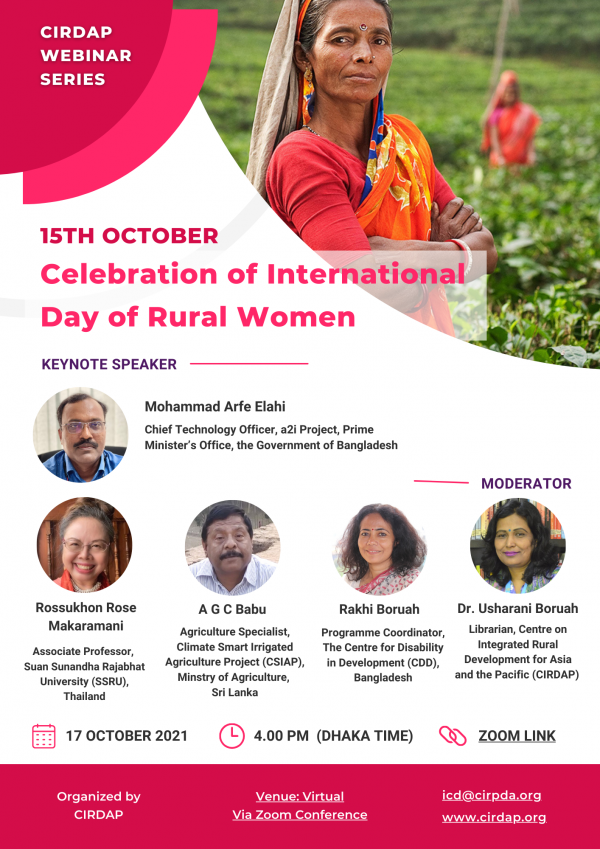
On 17th October, 2021 CIRDAP celebrated “the International Day of Rural Women” through the webinar and this year’s theme is “Rural Women Cultivating Good Food for All.” In his opening remark CIRDAP Director General Dr. Cherdsak Virapat said, “CIRDAP is supporting rural women’s and girls’ works in every aspect in the society. CIRDAP works towards gender equality, women’s education, and decent jobs which helps rural women to be empowered. It is an opportunity to acknowledge the progress being made in rural areas by the rural women. On behalf of CIRDAP, I call for immediate global attention to ensure women’s full and effective participation and equal opportunities for leadership at all levels of decision-making in political, economic and public life.” In the event, there were four speakers from different organizations. The Keynote Speaker is Mr. Arfe Elahi, Chief Technology Officer, a2i Project, Prime Minister’s office, the Government of Bangladesh. On behalf of him, Iqbal Hossain Sohel from a2i project gave the presentation on “Sharing the Covid- 19 Pandemic and Vaccinations programme information to Rural Women through Union Digital Centre (UDC) of a2i project, the Government of Bangladesh”. Ms. Rossukhon Rose Makaramani, Associate Professor, Suan Sunandha Rajabhat University (SSRU), Thailand spoke about the effect of Covid-19 on Rural Girls/Women Education in Thailand. Then, Mr. George C. Babu, Agriculture Specialist, Climate Smart Irrigated Agriculture Project (CSIAP), Ministry of Agriculture, Sri Lanka presented the scenario of the Impact of Covid-19 on Rural Women livelihood in Sri Lanka. Finally, Impact of Covid-19 on Rural Women with disabilities in Bangladesh: A Perspective was discussed by Ms. Rakhee Boruah, Programme Coordinator, The Centre for Disability in Development (CDD), Bangladesh. After all the presentations, an effective and fruitful discussion and Q/A sessions was happened amongst the experts, invitees and participants of the different organizations.

Latest News, Webinar report/abstract

International Day on Disaster Reduction – “Disaster Management in Bangladesh”

On 13th October, 2021 CIRDAP organized an important and significant webinar on “International Day for disaster Reduction. CIRDAP Expert Prof. Dr. Mehedi Ahmed, Dept. of Civil Engg. BUET gave a presentation on the topic of “Disaster Management of Bangladesh”. Abstract of the webinar Bangladesh is beset with numerous natural hazard such as cyclone, earthquakes, floods, landslides, riverbank erosion, tornados etc. Also, there are manmade disasters such as urban fire, building collapse etc. The 1970 cyclone killed almost half a million people of this country and 1897 Great Indian earthquake killed almost 1900 people. Also, the 1988 and 1998 floods inundated almost 70% areas of Bangladesh for almost three months causing distress to the people and the economy.  In this presentation a short summary of different natural and manmade disasters has been presented. Later Bangladesh’s Preparedness to Manage Earthquake Disaster related issues are discussed in detail. For details please see the link below: click here

Latest News, Webinar report/abstract

Webinar Lecture on Resilient strategies for aquaculture and fisheries to face the extreme weather shocks

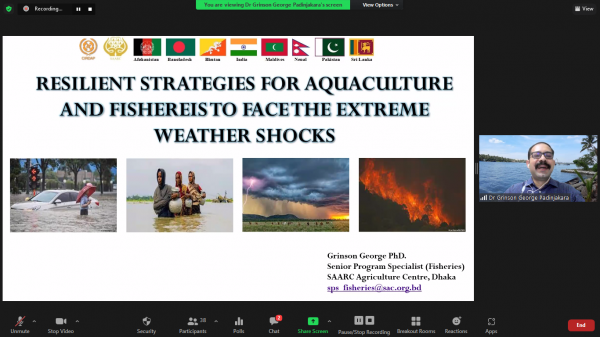
On 9th October, 2021 CIRDAP organized a webinar lecture on Resilient strategies for aquaculture and fisheries to face the extreme weather shocks by CIRDAP Expert Dr. Grinson George Senior Programme Specialist (fisheries), SAARC Agriculture Centre, Dhaka, Bangladesh   Abstract of the webinar lecture The planet earth is challenged by the impacts of the climate change. Changes in climate variables have crossed threshold levels at many regions and have resulted in weather shocks such as floods, glacial outbursts, droughts, wild-fire, marine heat waves, extreme-events and many more. These changes are having far reaching impacts on the ecosystems both in the oceans, coastal areas and inland aquatic bodies. In this lecture we are looking into the reasons for such changes and how they are impacting the ecosystems and resources. Further, we analyze the future scenarios based on model simulations. Adaptation strategies, diversified livelihood options for the vulnerable, technologies to mitigate or adapt to the weather shocks with emphasis on aquaculture and fisheries is discussed. Furthermore, the involvement of citizens in dealing with bad weather conditions or data generation on critical aspects is put forth as a solution to bridge the gap between policy planners and society for a better climate-friendly framework. Guidelines with respect to a policy for proper resilient strategies are discussed from the organizational point of view for the South Asian region. For details please see the link below: click here

Latest News

Message from Dr. Cherdsak Virapat, Director General, CIRDAP On the International Day of Rural Women

Today, we celebrate the International Day of Rural Women at the Centre on Integrated Rural Development for Asia and the Pacific (CIRDAP). The day of 15 October was established at the United Nations General Assembly in its resolution 62/136 of 18 December 2007; this international day recognizes “the critical role and contribution of rural women, including indigenous women, in enhancing agricultural and rural development, improving food security and eradicating rural poverty.” This year’s theme of the International Day of Rural women is “Rural Women Cultivating Good Food for All.” Rural Women and girls play an important role in food cultivation, processing and preparation. They work in the paddy fields with & without men. At home they are farming vegetables, rearing cattle’s, poultry and producing various types of food & crops. The rural women take care of soil, water & crops that help them to increase household income and secured food for the family. Rural women’s role in food production helps their family members to have nutritious food. Thus, it helps reduce hunger and malnutrition in their communities. The Covid- 19 pandemic has disrupted the rural economy in particular in Asia and the Pacific countries. Rural women are also suffering most from the Covid 19 and many family members have lost their jobs. Due to the economic losses many rural people and girls, women are suffering from food crisis not having enough healthy food. CIRDAP is supporting rural women’s and girls’ works in every aspect in the society. CIRDAP works towards gender equality, women’s education, and decent jobs which helps rural women to be empowered. It is an opportunity to acknowledge the progress being made in rural areas by the rural women. On behalf of CIRDAP, I call for immediate global attention to ensure women’s full and effective participation and equal opportunities for leadership at all levels of decision-making in political, economic and public life. CIRDAP is proud to organize a webinar for celebrating the International Day of Rural women on 17th October 2021 on the topic related to the Covid-19 pandemic and role of women in managing it. Thank you.

Latest News

Message from Dr. Cherdsak Virapat, Director General, CIRDAP On the International Day for Disaster Risk Reduction

Today, we celebrate the International Day for Disaster Risk Reduction at the Centre on Integrated Rural Development for Asia and the Pacific (CIRDAP). The day of 13 October was established at the United Nations General Assembly in 1989, to promote a global culture of risk-awareness and disaster reduction. On behalf of CIRDAP, I call for immediate global attention on planning and implementation of disaster risk reduction by mean of hazard vulnerability assessments, disaster early warning, mitigation, preparedness and response. It is an opportunity to acknowledge the progress being made toward reducing disaster risk and losses in lives, livelihoods and health in line with the Sendai Framework for Disaster Risk Reduction 2015-2030 adopted at the Third UN World Conference on Disaster Risk Reduction in Japan in March 2015. This year’s theme is about aligning implementation of the Sendai Framework for Disaster Risk Reduction with implementation of the SDGs and the Paris Agreement commitments targeting substantially enhance international cooperation to developing countries through adequate and sustainable support to complement their national actions for implementation of the present framework by 2030[1] and to reduce the disaster risks and losses. CIRDAP is proud to organize a webinar in collaboration with Prof. Mehedi Ansary, Bangladesh University of Engineering and Technology (BUET) for celebrating the International Day for Disaster Risk Reduction entitled “Disaster Management in Bangladesh”. CIRDAP looks forward to promoting its emerging issues on integrated rural development including natural disaster risk reduction, climate change impacts, & water resource management programme in the years to come.

Scroll to Top